| Latest Innovations | |
| Chemical Guys News | |
| Exterior How-To's | |
| Interior How-To's | |
| Drying How-To's | |
| Ceramic How-To's | |
| Detailing University |
Water spots are annoying. Like, really annoying. You wash your car, dry it off, step back to admire your work, and then the sun hits the paint just right and—boom—little white circles everywhere.
Cool.

The frustrating part is that water spots aren’t always just something sitting on top of the surface. If they hang around long enough, they can actually become a much bigger problem.
And before we get too deep into cars, here’s the twist: the same thing is probably happening on your shower doors at home. Yep. We’re detailing the bathroom now.
So What Even Is a Water Spot?
Basically, water spots are what gets left behind after water dries.
Tap water and hose water usually contain minerals like calcium and magnesium. The water evaporates, but those minerals don’t. They stay behind on the surface and create those cloudy little rings we all love so much.

If you live somewhere with hard water, you’ve probably seen this everywhere. On your paint. On your windows. On your faucets. On your shower doors. Once you notice it, you start seeing it everywhere.
Are Water Spots Actually Bad?
They can be.
Fresh water spots are usually pretty easy to deal with. If you catch them early, a normal wash or glass cleaner might take care of them. But once those minerals sit on the surface, bake in the sun, and go through a few more rounds of getting wet and drying again, they can get stubborn fast. Eventually, they can etch into paint or glass. And once you get to that point, you’re not just wiping off a dirty spot anymore. You’re dealing with something that has really bonded to the surface.

So if you see water spots, don’t give them time to get comfortable.
How Do You Get Water Spots Off Your Car?
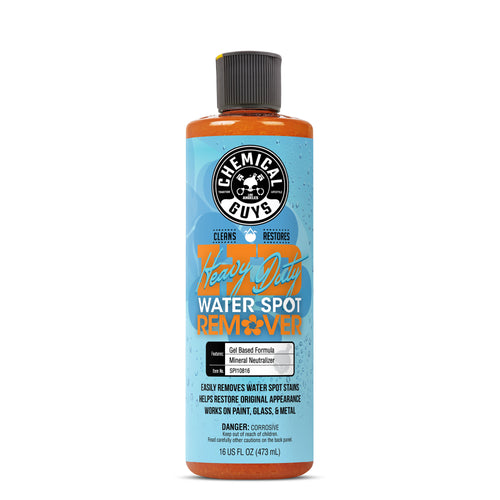
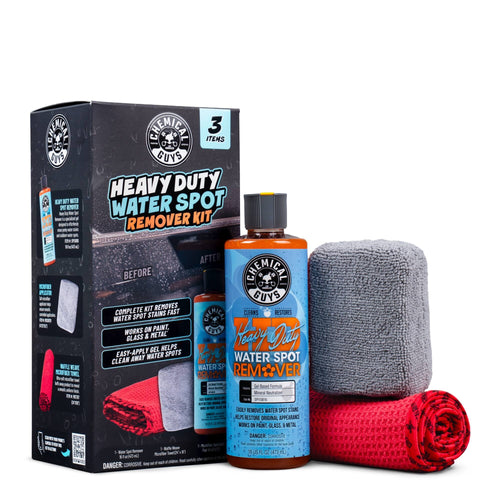
First, clean the surface. Sounds obvious, but it matters. If you’re working on glass, start with Chemical Guys Streak Free Window Clean Glass Cleaner and a clean microfiber towel. Get all the normal dirt and grime off first so you can see what you’re actually working with. If the spots disappear, great. You’re done. If they’re still sitting there looking back at you, it’s time to step things up with the Heavy Duty Water Spot Remover Kit. It includes the Water Spot Remover, applicator, and microfiber towel you need to attack stubborn mineral deposits without piecing everything together yourself.

Apply a few drops to a microfiber applicator and work it into the affected area. The big thing here is: don’t just wipe it on and immediately wipe it off. Work it in. Go up and down, then left and right. Give the product a chance to actually work on those mineral deposits. Once you’re done, wipe everything clean. Water, Streak Free or a quick detail spray can help remove the leftover residue and neutralize the surface. Then take another look. That cloudy, crusty mess should be looking a whole lot better.
And Then Protect It
This is the part people skip. You remove the water spots, everything looks good again, and then you leave the surface completely unprotected. Guess what happens next time it rains, or you park next to a sprinkler? Exactly.
If you’re working on paint, follow up with HydroCharge+ Ceramic Spray Coating. It adds a slick, high-gloss layer of ceramic protection that helps water bead up and roll away instead of hanging around on the surface.
For glass, that’s where HydroView Ceramic Glass Cleaner & Coating comes in. Once the glass is clean and the water spots are gone, spray HydroView onto the surface and wipe it down with a clean microfiber towel. Now the glass is more hydrophobic, which basically means water has a harder time sticking around.

And this is where things start getting interesting.
Now Go Look at Your Shower Door
Seriously. Go look at it. See that cloudy buildup? Those white marks? That haze that never seems to go away no matter how many times you hit it with normal glass cleaner? Yeah. Those are water spots too. Your shower glass is basically dealing with the same thing as your car. Water hits the surface. Water dries. Minerals stay behind. Then you shower again. And again. And again. Eventually, the glass starts looking permanently cloudy. So we thought: why not treat it like automotive glass?
Yes, You Can Detail Your Shower Glass
Turns out, the same detailing routine you use on your car works surprisingly well in the bathroom, too. The game plan is simple: clean it, remove the water spots, then protect it.

First, clean the shower glass with Streak Free Window Clean Glass Cleaner and a microfiber towel. You want to get the everyday grime and residue out of the way first so you can see what you’re actually dealing with.
Still see those cloudy spots? That’s when you reach for Heavy Duty Water Spot Remover.
Apply a few drops to a microfiber applicator and actually work the gel into the glass. That part matters. You’re not just wiping it on and immediately wiping it off—you want to work it back and forth across those stubborn mineral deposits.
Once the Water Spot Remover has done its thing, use water or Streak Free to help remove the product and neutralize the surface. Then give the glass a feel.
Seriously.

Before treatment, heavy mineral buildup can actually make the glass feel gritty or raspy. Once that buildup is gone, the difference can be surprisingly satisfying—the glass feels smooth again. And when you step back and see how clear the glass actually is, you might have the same reaction we did: “Wait…that was under there the whole time?” But don’t stop there. You just did all that work to get rid of the water spots. Now let’s make it harder for them to come back.
Then Ceramic Coat the Shower
This might sound a little excessive. It isn’t. Once the glass is clean and the water spots are gone, finish it with HydroView Ceramic Class Cleaner & Coating. Spray it on, wipe it down, and now you’ve got a layer of ceramic protection on the shower glass. The cool part is that you can actually see the difference. On untreated glass, water tends to sit there and cling to the surface.

On treated glass, more of it beads up and runs down. Which means less water sitting around. Less water sitting around means fewer mineral deposits getting left behind. And now keeping your shower glass clean gets way easier. Pretty cool for something that was originally sitting in the garage.
Which Got Me Thinking…
What else in the bathroom can we attack with detailing products? And this is where I had a bit of a revelation. I grabbed a Chemical Guys Spinner Drill Brush and used it on some stubborn grime and mildew around my bathroom tile. I know the product title says carpet but just take a look at the box and notice that it says "Deep cleans ... bathrooms, kitchens, and more!"
And wow!

Stuff that I’d scrubbed by hand before suddenly started coming off way easier. That moment was basically: “Why have I not been doing this the whole time?” The drill brush gives you way more agitation than a normal hand brush, and on the right tile and grout surfaces, it can make a huge difference. Instead of scrubbing the same spot over and over with your arm, the drill does the hard part for you. Very satisfying.
Your Garage Might Be Hiding Bathroom Cleaning Tools
Once you start thinking about it, a lot of detailing products make sense outside the car. Microfiber towels? Of course. Detailing brushes? Absolutely. All-purpose cleaner?Yep. Drill brushes? Apparently, yes. Something like Nonsense All Purpose Cleaner can also make sense for compatible hard surfaces when you’re dealing with general dirt and grime. Pair it with the right brush, and suddenly you’re not really “cleaning the bathroom” anymore. You’re detailing it. And honestly, that sounds way better.

The Big Takeaway
Water spots don’t really care where they are. They can show up on your windshield, your paint, your shower glass, or anywhere else hard water gets a chance to dry.
The trick is the same:
Figure out what you’re dealing with. Use the right cleaner. Use the right tool. Remove the contamination. And protect the surface so you don’t have to do the whole thing again next week.
So next time your shower glass looks cloudy or your tile is looking a little rough, maybe don’t head straight for the cleaning closet. Check the garage first. You might already have exactly what you need.