Drying technique matters as much as towel choice. Even the best car drying towel can cause problems if used incorrectly, and a few adjustments to your process make a meaningful difference in the final result.
Start With A Final Rinse
Before reaching for the towel, do a slow final rinse using low water pressure. For the full wash process that precedes this step, see our guide on how to wash a car. This sheeting rinse removes the last layer of surface water from flat panels and reduces the total volume your towel needs to absorb. Fewer passes mean less contact and a lower risk of residual contamination marking the paint.
Work Top To Bottom In Sections
Start at the roof and work downward, roof, windows, hood and trunk, then doors and lower body. Drying from the top prevents already-clean panels from being re-contaminated by water running down from panels above. Use straight strokes and lift the towel cleanly between passes, rather than dragging it.
Keep The Towel Damp, Not Saturated
A slightly damp towel glides more smoothly than a completely dry one, reducing the risk of drag. When the towel is saturated and no longer absorbs effectively, wring it out before continuing. A saturated towel smears water rather than lifting it, which causes streaking on both paint and glass.
Address Gaps And Recesses Last
Door jambs, mirror housings, grille sections, and panel gaps hold water that drips onto dried panels. After finishing the main panels, open doors and the hood to blot these areas dry. This prevents the water spots that form when trapped water escapes onto the paint after the drying session ends.
Products That Complete Your Drying Routine
A great drying towel performs best as part of a system. The products we pair with it, for glass, for trim, and for towel care, determine how clean, streak-free, and long-lasting our results are across every wash.
Ultimate Absorbency For Every Surface
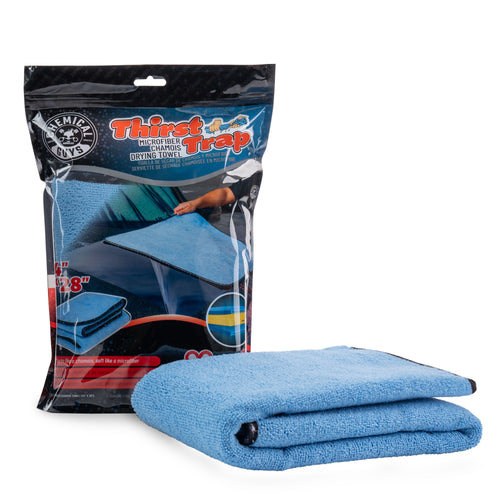
Our Thirst Trap Microfiber Chamois Towel combines a synthetic chamois core with a soft microfiber exterior, delivering the best of both materials in one tool. The chamois interior holds up to half a gallon of water and wicks quickly, while the microfiber exterior maintains a consistently soft, paint-safe contact surface that does not harden or scratch over time like traditional chamois towels. Measuring 24 by 28 inches, it works safely on paint, clear coats, glass, and more. Wipe in slow strokes, wringing as needed. Machine wash in hot water with our Microfiber Wash Cleaning Detergent, and dry on low heat. Never use fabric softener or dryer sheets; these permanently reduce absorbency.
Crystal-Clear Finish On Glass
Our Streak Free Window Clean Glass Cleaner is a tint-safe, ammonia-free formula for interior and exterior glass. We formulated it to remove dirt, fingerprints, grease, and grime without leaving residue or streaks. Static-inhibiting agents help resist dust after cleaning, so glass stays cleaner between applications. Mist the glass surface, wipe with a clean microfiber towel, then buff with a second dry towel for full optical clarity. For interior windows, spray directly onto the towel to prevent misting onto the surrounding trim. Our formula is safe for all factory- and aftermarket-tint films.
Towel Care That Preserves Performance
Our Microfiber Wash Cleaning Detergent is a specialty formula designed to clean and restore microfiber fabrics. Check out our full guide on how to clean microfiber towels for the complete wash process. Regular household detergents leave residue that clogs fibers, stiffens the fabric, and reduces absorbency over time. We use Clean Rinse technology that releases dirt, wax, grease, and product buildup from within each fiber strand and evacuates completely, leaving nothing behind but restored microfiber. It is all-natural, bleach-free, and contains no fabric softeners. Use 1 oz for small loads, 2 oz for medium loads, or 3 oz or more for large loads. Machine wash in hot water and dry on low heat.
Why The Right Drying Towel Matters Every Wash
The drying step is the last contact between a tool and your paint after every wash. Here is what the right towel and process protect:
- Prevents Water Spots: A high-absorbency towel removes water before it evaporates, preventing mineral deposits from forming on the surface and keeping the finish clean and spot-free.
- Protects Clear Coat: Soft, high-pile microfiber reduces friction during drying, helping protect the clear coat from micro-scratches that build up over time with rougher materials.
- Works With Protection: Ceramic coatings and sealants cause water to bead on the surface. A high-absorbency towel collects these beads cleanly without disturbing or degrading the protective layer beneath.
- Keeps Glass Clear: Streaky glass reduces visibility and makes the car look unfinished. A dedicated glass towel used with the right cleaner produces clarity that standard drying towels alone cannot deliver.
- Extends Towel Life: Washing microfiber with a purpose-built detergent after each use keeps fibers open, soft, and absorbent, so every drying session performs as well as the first.
- Completes The Wash System: The right drying towel is the final step in a complete wash process. Using the correct tool at this stage is what turns a clean car into a properly finished one.
Your drying towel does more than remove water; used correctly, it finishes the job the wash started and sets the surface up for whatever protection step comes next.